Class C Ip Checker
Enter up to 40 Domains (Each Domain must be on separate line)
Class C IP Checker
Two websites can look unrelated and still sit in the same IP neighborhood.
This free tool resolves domains to their IP addresses and groups them by Class C range (the first three octets of an IPv4 address), so you can see which sites share the same block.
Run the Check
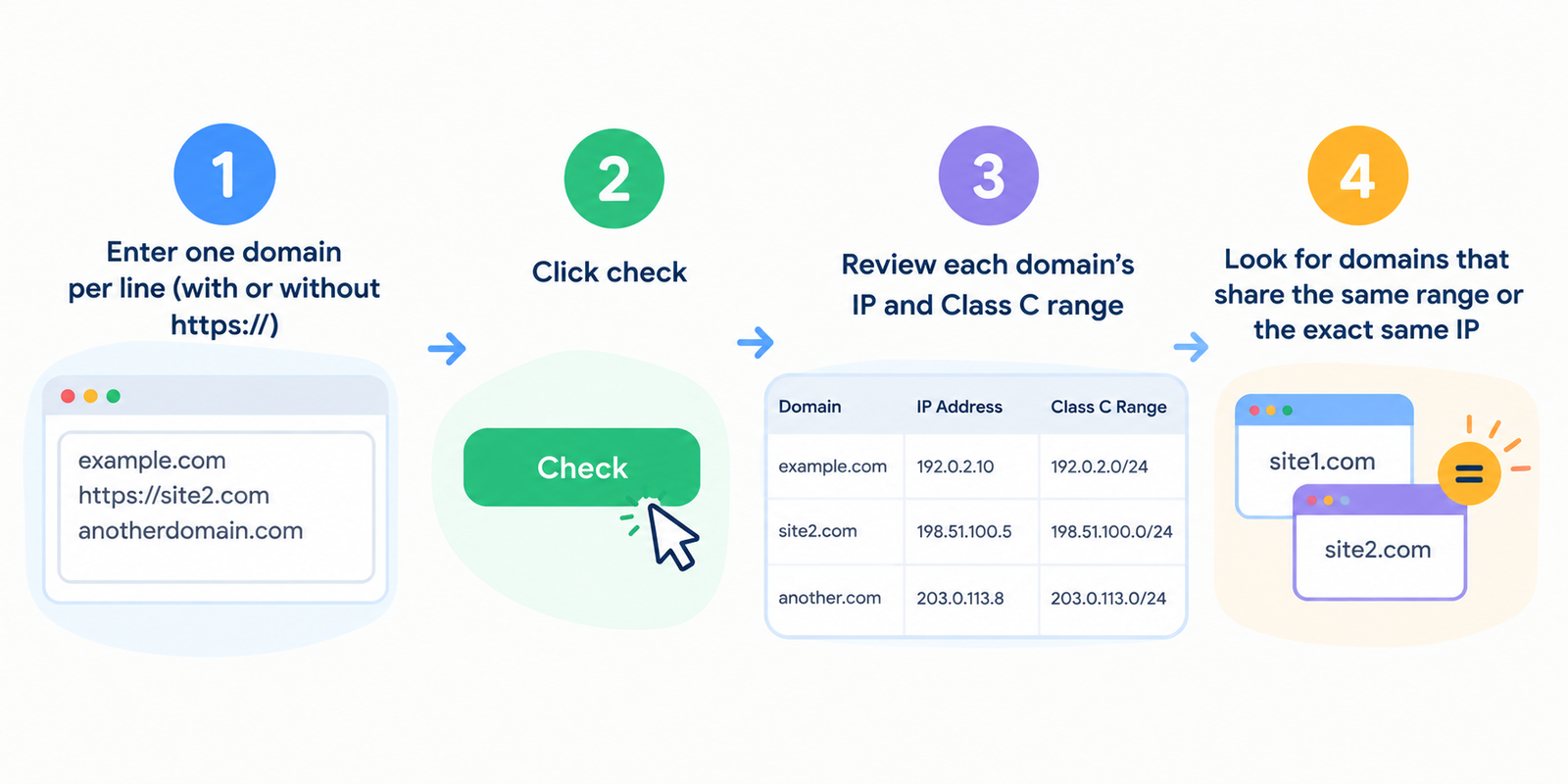
- Enter one domain per line (with or without
https://) - Click check
- Review each domain’s IP and Class C range
- Look for domains that share the same range or the exact same IP
Useful when comparing a list of sites, not just a single domain.
What “Class C” Means in Plain Terms
An IPv4 address looks like this:
203.0.113.45
In older networking language, the Class C block is the first three parts:
203.0.113.x
So:
203.0.113.10203.0.113.45203.0.113.200
…are all in the same Class C neighborhood.
Today, engineers more often say /24 subnet, but many SEO and hosting tools still use the term “Class C.”
What the Results Help You See
| Finding | Practical meaning |
|---|---|
| Different Class C ranges | Sites resolve to different IP neighborhoods |
| Same Class C, different IPs | Likely same broad network/data-center block |
| Exact same IP | Domains point to the same address (common on shared hosting or one server) |
| CDN / proxy IPs | Public IP may belong to Cloudflare or another edge network, not the origin server |
Shared hosting often places many unrelated websites in the same range. That alone is normal and not automatically a problem.
Sensible Uses of This Tool
Infrastructure awareness
See whether several of your domains currently resolve into the same IP block.
Hosting / migration checks
After moving servers or DNS, confirm domains no longer share an old IP neighborhood (when that is your goal).
List review
When evaluating a batch of domains or referring sites, identify clusters on the same IP or same Class C range.
Research context
Combine with hosting, WHOIS, and DNS checks for a fuller picture of how domains are set up.
This is an IP neighborhood lookup, not proof of ownership, penalty status, or link value.
Important Reality Check
- Many legitimate sites share IP ranges on shared or cloud hosting
- Being in the same Class C does not automatically mean a Google penalty
- CDN services can make many different sites appear to share similar edge IPs
- Link quality depends on far more than IP diversity
- Manipulative link networks can violate search engine spam policies
Use the data for technical understanding. Don’t treat Class C differences as a ranking trick.
How to Interpret Shared Ranges
Exact same IP
Often means shared server/hosting account, reverse proxy, or intentional multi-site setup on one address.
Same Class C, different final octet
Common in hosting networks and data centers. Investigate further before drawing conclusions.
Different ranges
Domains are not in the same immediate IPv4 neighborhood — though they may still share ownership, CMS, analytics, or other signals.
For CDN-fronted sites, check origin hosting separately when possible.
FAQ
Is this tool free?
Yes. Standard lookups do not require an account.
Does same Class C hurt SEO by itself?
Not automatically. Shared ranges are common. Problems are more about overall site quality, spam patterns, and unnatural link schemes — not a single IP octet rule.
Why do Cloudflare sites look similar?
Because the public IP often belongs to the CDN edge, not the real origin server.
Does Class C apply to IPv6?
“Class C” is an IPv4 concept. IPv6 uses different addressing and grouping.
Can subdomains have different IPs?
Yes. Always check the exact host you care about.
Related tools
Note: Results are based on current DNS resolution. IPs can change after hosting moves, DNS updates, or CDN configuration changes. Re-check when infrastructure changes.