If you've been in SEO for more than five minutes, you've heard the term "Domain Authority." It's that elusive score everyone wants to increase but few fully understand.
Our Domain Authority Checker gives you a clear look at this metric – how your site stacks up against competitors, whether your link‑building efforts are paying off, and where you stand in your industry.
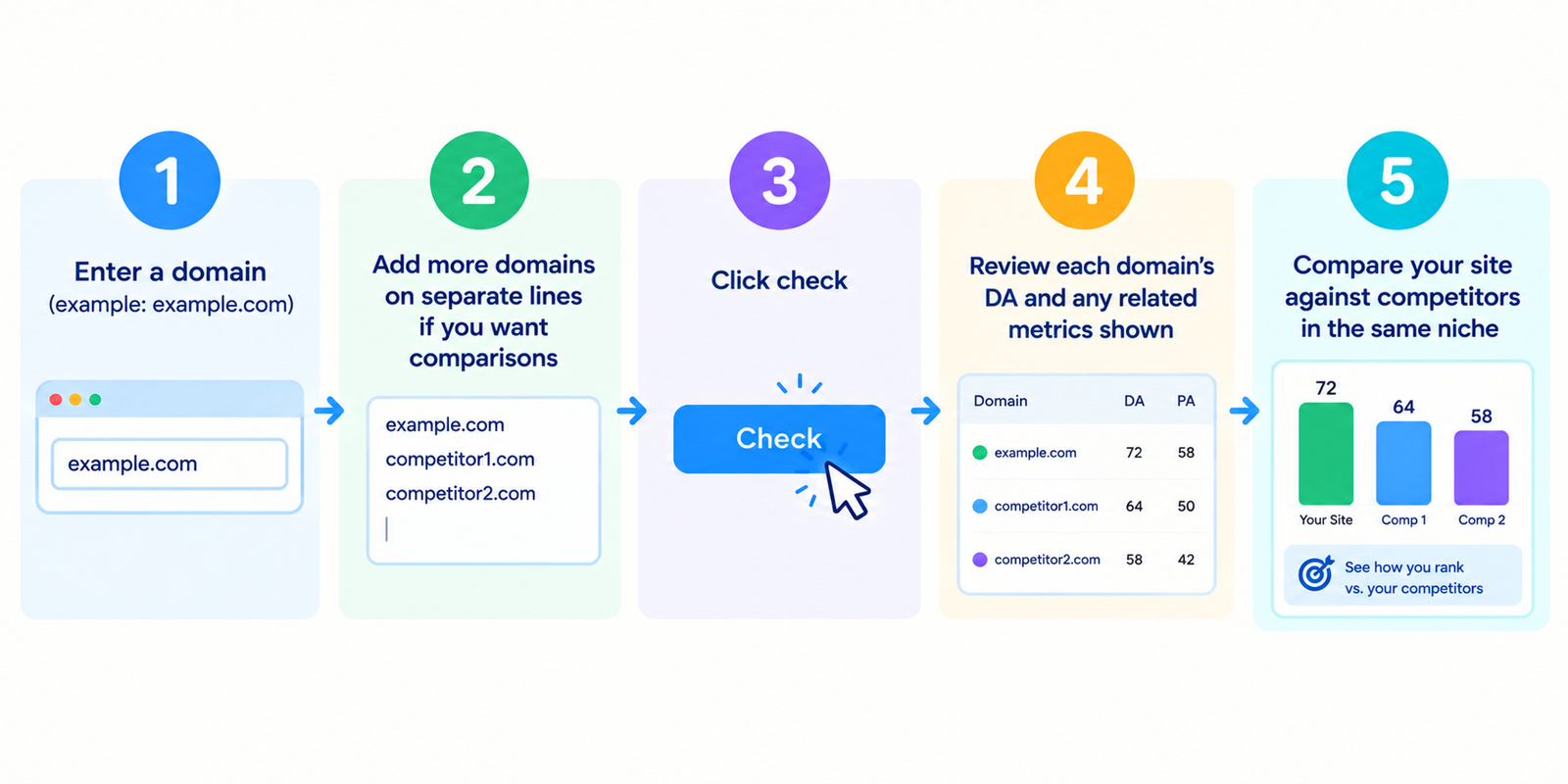
Enter one or more domains. One per line. Get the Domain Authority score for each, plus a few related metrics. No complicated dashboards, no sales pitches. Just the number and what it means.
Domain Authority is a score developed by Moz that predicts how likely a website is to rank on search engine results pages. The score runs from 1 to 100 – higher scores mean a greater ability to rank compared to competitors.
Google doesn't use DA. It's not a ranking factor. Instead, DA is a third‑party metric that tries to approximate search engine behaviour. Think of it as a speedometer for your SEO efforts: useful for gauging progress, but not the thing that actually moves the car.
Moz calculates DA using a machine learning algorithm that primarily looks at backlink data – the number of linking root domains, the quality of those links, and the overall link profile of your site.
Years ago, Google showed a PageRank score in its toolbar. SEOs could look up any website and see its PageRank on a 0‑10 scale. Then Google removed the toolbar, and the SEO world scrambled for a replacement.
Moz stepped in with Domain Authority. It's essentially the spiritual successor to PageRank – a single number that tries to capture a website's "strength." Other tools soon followed with their own versions: Ahrefs has Domain Rating, SEMrush has Authority Score, Majestic has Trust Flow.
The key difference: PageRank was (and still is) an actual Google ranking signal. DA is a simulation. PageRank is real but hidden. DA is visible but not used by Google.
While Moz keeps the exact formula proprietary, the main inputs are well understood:
Number of linking root domains – How many unique websites link to you. One site linking to you 100 times counts less than 100 different sites linking to you once.
Quality of linking domains – A link from a major news site or a .gov domain is worth far more than a link from a random blog with no traffic. Your DA reflects the authority of the sites that link to you.
Total backlinks – More links generally help, but only if they're from quality sources. A thousand low‑quality links can actually hurt.
Link diversity – A natural link profile includes links from many different types of websites – blogs, news sites, directories, forums. Unnatural patterns (like all links coming from the same source) are red flags.
Step 1 – Open the Domain Authority Checker on bingowebrabbit.com.
Step 2 – Enter one or more domains. One per line. Examples:
bingowebrabbit.com
competitor-site.com
another-business.net
Step 3 – Click "Check Authority."
Step 4 – Wait a few seconds. The tool queries Moz's API and returns the results.
Step 5 – Read your scores. Along with DA, you'll typically see:
Step 6 – Compare and plan. Use the numbers to see where you stand against competitors. If someone has a higher DA, they likely have stronger backlinks or a more established link profile.
There's no universal answer. "Good" is relative to your industry and competition.
New websites – Start at 1. Most reach 10–15 within six months of consistent content creation and basic link building.
Average websites – Most sites sit between 20 and 50. The median is around 30–35.
Good scores – Generally considered between 50 and 60. This puts you ahead of most sites.
Excellent scores – Above 60. Only about 5% of all domains reach this level. It requires significant link building over months or years.
Elite scores – Above 70. Less than 1% of domains achieve this. Think major brands, news organisations, and government sites. Google and Facebook score 99.
The most useful comparison is against your direct competitors. If they average DA 45 and you're at 30, you have work to do. If they're all around 25, you're fine.
Domain Authority is useful. It's also flawed. Don't treat it as gospel.
Not a Google metric – Google doesn't use DA. It's a third‑party estimate. John Mueller, Google's Search Advocate, has repeatedly said that DA is not a ranking factor.
Manipulable – People can artificially inflate DA through low‑quality link schemes. A high DA doesn't guarantee high‑quality content or genuine trust.
Different tools, different scores – Moz, Ahrefs, and SEMrush all calculate their own versions. A site with DA 40 in Moz might show DR 55 in Ahrefs. Pick one tool and stick with it for consistent tracking.
Incomplete data – Many websites block Moz's crawler. Those sites may have inaccurate or missing DA scores.
Accuracy concerns – Some SEOs report DA's accuracy hovers around 30% for predicting actual rankings. It's a directional indicator, not a precise science.
Fluctuates without changes – Moz occasionally updates its algorithm. Your score can drop even if your site hasn't changed. Use it as a comparative metric ("Am I gaining on competitors?") rather than an absolute one.
You can't raise DA directly. You raise it by doing the things that make your site genuinely authoritative.
Create high‑quality, linkable content – The best backlinks come from content people want to reference. Original research, detailed guides, infographics, and data‑driven articles attract links naturally.
Earn backlinks from reputable sites – One link from a major news site or industry authority is worth more than fifty links from low‑quality directories. Focus on quality over quantity.
Remove toxic backlinks – If you have spammy links pointing to your site, use Google's Disavow Tool to tell Google to ignore them. Cleaning up your link profile can prevent penalties and help your DA over time.
Improve your on‑page SEO – Well‑structured pages with proper headings, internal links, and fast loading times are more likely to attract and retain links. Google (and Moz's algorithm) notices these signals.
Be patient – DA changes slowly. Most meaningful increases take months or years. A site that's been building authority for five years will always outrank a new site, all else being equal.
This is where DA becomes most useful. Run your top competitors through the checker. Note their scores. Then ask:
Use this information to prioritise. If a competitor with DA 55 is outranking you on key terms, they likely have stronger backlinks. Focus on link building. If a competitor with DA 25 is outranking you, the problem isn't authority – it might be content quality, technical SEO, or keyword targeting.
What's the difference between Domain Authority and Page Authority?
Domain Authority measures your entire website. Page Authority measures a single page. A page on a low‑DA site can have high PA if it attracts many specific, relevant backlinks.
Does DA affect my Google rankings?
No. It's a third‑party metric. Google doesn't see or use it. But the factors that increase DA (quality backlinks, good content, technical health) also improve your actual Google rankings.
Why did my DA drop?
Moz may have updated its algorithm. Or a high‑authority site that linked to you may have lost its own authority. Or competitors gained ground faster than you. Check your backlink profile before panicking.
Can I check DA for free?
Yes. Our tool provides free DA checks for normal usage. Bulk commercial use may require API access.
How often should I check my DA?
Once a month is plenty. DA changes slowly. Checking daily will only frustrate you.
What's a good DA for a new site?
One. Every site starts at 1. Don't worry about it until you've been publishing for at least six months.
A local plumbing business runs its own domain through our checker. Score: DA 12. It runs three local competitors. One scores DA 8 (weak), another DA 15 (similar), and another DA 34 (strong). The business now knows exactly who to catch up to and who to ignore.
It spends the next six months getting listed in local directories, earning mentions from local news sites, and writing helpful plumbing guides. Six months later, its DA is 22. It's still behind the strongest competitor at 36, but closing the gap. Traffic improves accordingly.
Domain Authority is a tool, not a trophy. It helps you benchmark your site against competitors and track your SEO progress over time. But it's not a Google ranking factor, and fixating on it won't directly improve your positions.
Use it wisely: compare, not obsess. Track trends, not daily fluctuations. And remember that the best way to raise your DA is to build a genuinely useful website that people want to link to – not to chase the number itself.