Mozrank Checker
Enter a URL
MozRank Checker
Want a quick sense of how strong a website's link profile looks? Enter a domain below and this free tool will show its MozRank-style authority score. It can be useful for estimating link popularity and comparing websites during SEO research.
How to Use It
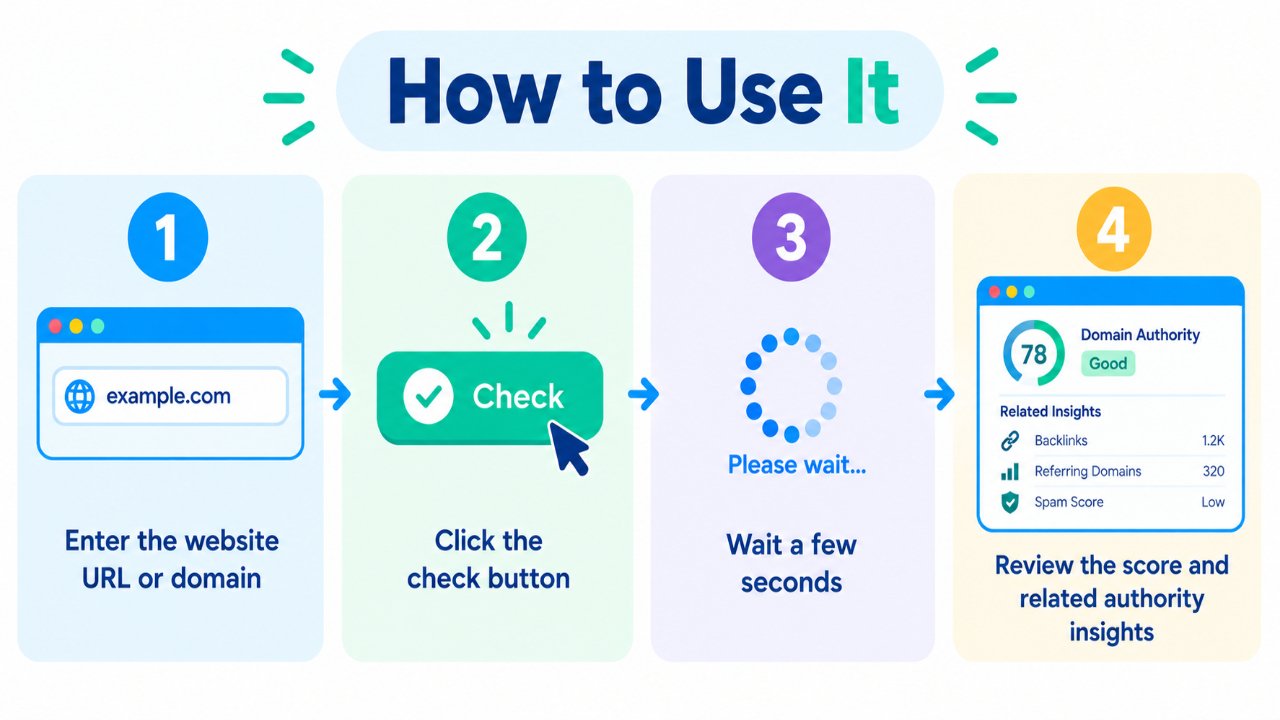
- Enter the website URL or domain.
- Click the check button.
- Wait a few seconds for the result.
- Review the score and any related authority information provided by the tool.
No account is required.
What MozRank Is
MozRank is a link-based metric historically associated with Moz. It was designed to indicate the link popularity of a page based on the links pointing to it, using a scale that was commonly represented from 0 to 10.
In simple terms, a higher score generally indicated a stronger link profile according to the metric's calculation.
- Lower scores can be common for newer or less-linked websites.
- Higher scores generally indicate stronger link signals within the metric's underlying data.
It is important to understand that MozRank is not a Google ranking factor. It is a third-party SEO metric intended for analysis and comparison.
Why People Check MozRank-Style Scores
Third-party authority metrics can still be useful during SEO research. Website owners and marketers may use them to:
- Get a rough idea of link strength.
- Compare their website with competitors.
- Monitor changes in a backlink profile over time.
- Identify large differences between competing domains.
- Support basic SEO audits and link research.
It is best to treat the score as one data point rather than a final measurement of a website's ranking potential.
How to Read the Score
There is no universal interpretation that applies to every SEO tool because databases and scoring systems can differ. As a general reference:
- Lower scores — often seen on newer websites or sites with relatively few links.
- Mid-range scores — may indicate a more established website with a developing backlink profile.
- Higher scores — are more commonly associated with well-established websites that have accumulated substantial link signals.
A website should not try to increase a metric simply for the sake of getting a higher number. Building a useful website and earning relevant links naturally is more important than chasing an authority score.
What Can Improve Your Link Profile?
If you want to build stronger and more useful link signals, focus on sustainable SEO practices such as:
- Earning links from relevant and reputable websites.
- Publishing original content that people have a genuine reason to reference.
- Using sensible internal links to connect related pages.
- Promoting useful resources to relevant audiences.
- Avoiding manipulative, spammy, or low-quality link-building schemes.
- Building your backlink profile consistently over time.
A smaller number of relevant, editorially earned links can be more useful than a large number of unrelated or low-quality links.
MozRank vs Domain Authority
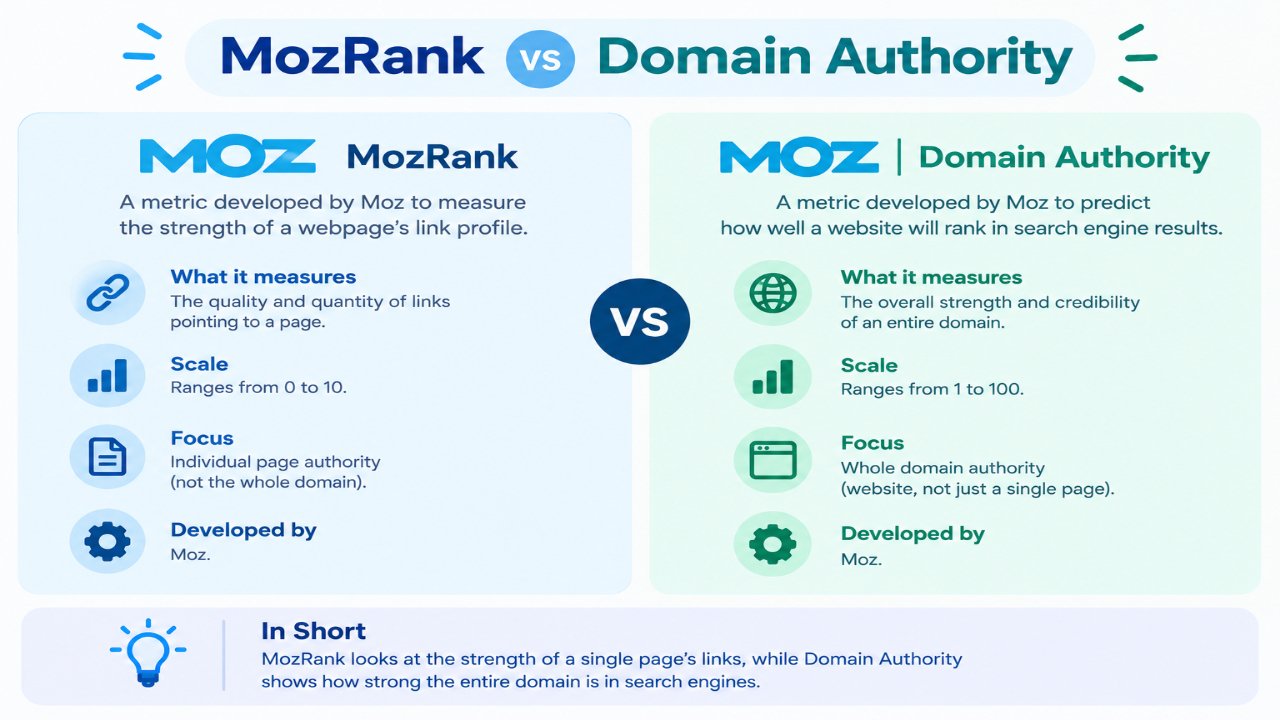
These two Moz-related metrics are sometimes confused, but they were designed for different purposes.
- MozRank — historically focused on link popularity and the link-based strength of a page.
- Domain Authority (DA) — a broader Moz predictive metric designed to estimate how likely a domain may be to rank compared with other domains.
Both are third-party metrics. Neither is an official Google score, and neither guarantees that a page or domain will rank in Google's search results.
Why Different SEO Tools May Show Different Scores
If you compare the same website across different SEO platforms, the numbers may not always match.
This can happen because tools may use:
- Different backlink databases.
- Different crawling schedules.
- Different ways of evaluating links.
- Different scoring formulas.
- Different update frequencies.
For this reason, it is usually more useful to compare websites using the same tool and methodology rather than treating one third-party score as an absolute measure of website quality.
Frequently Asked Questions
Is this MozRank Checker free?
Yes. You can check the available score without signing up for an account.
Does a higher MozRank mean higher Google rankings?
No. A higher third-party link metric does not automatically produce higher Google rankings. Search rankings depend on many factors, including content relevance, quality, links, technical accessibility, competition, and search intent.
Can I improve my score quickly?
Building a strong backlink profile usually takes time. Publishing useful content and earning relevant links naturally is generally more sustainable than trying to increase a metric through aggressive shortcuts.
Should I focus only on MozRank?
No. Look at the wider picture, including organic traffic, search visibility, content quality, technical website health, referring domains, and the relevance and quality of your backlinks.
Why do different tools show different numbers?
SEO platforms use different databases, crawling schedules, formulas, and update cycles. Small or large differences between tools are therefore possible. Use these metrics mainly for comparison and research rather than as absolute values.
Is MozRank an official Google metric?
No. MozRank is a third-party SEO metric and is not an official Google ranking score.
Related Free Tools
- Domain Authority Checker
- Backlink Checker
- Page Authority Checker
- Keyword Position Checker
- Whois Checker
Note
MozRank and similar authority metrics are third-party estimates. They can be useful for SEO research and website comparisons, but they should not be treated as official Google scores or guarantees of search rankings.