Free Page Authority Checker – Check PA Score for Any URL | Bingo Web Rabbit

Page Authority Checker


最多輸入 20 個連結(每個連結必須單獨一行)


驗證碼

處理中...


試用新的 URL

Page Authority Checker

Search engines rank pages, not just domains.

Page Authority (PA) is a third-party score (from Moz) that estimates the ranking strength of a specific URL on a 1–100 scale. This free tool lets you check PA for individual pages and compare them side by side.

How to Use It

Page Authority Checker
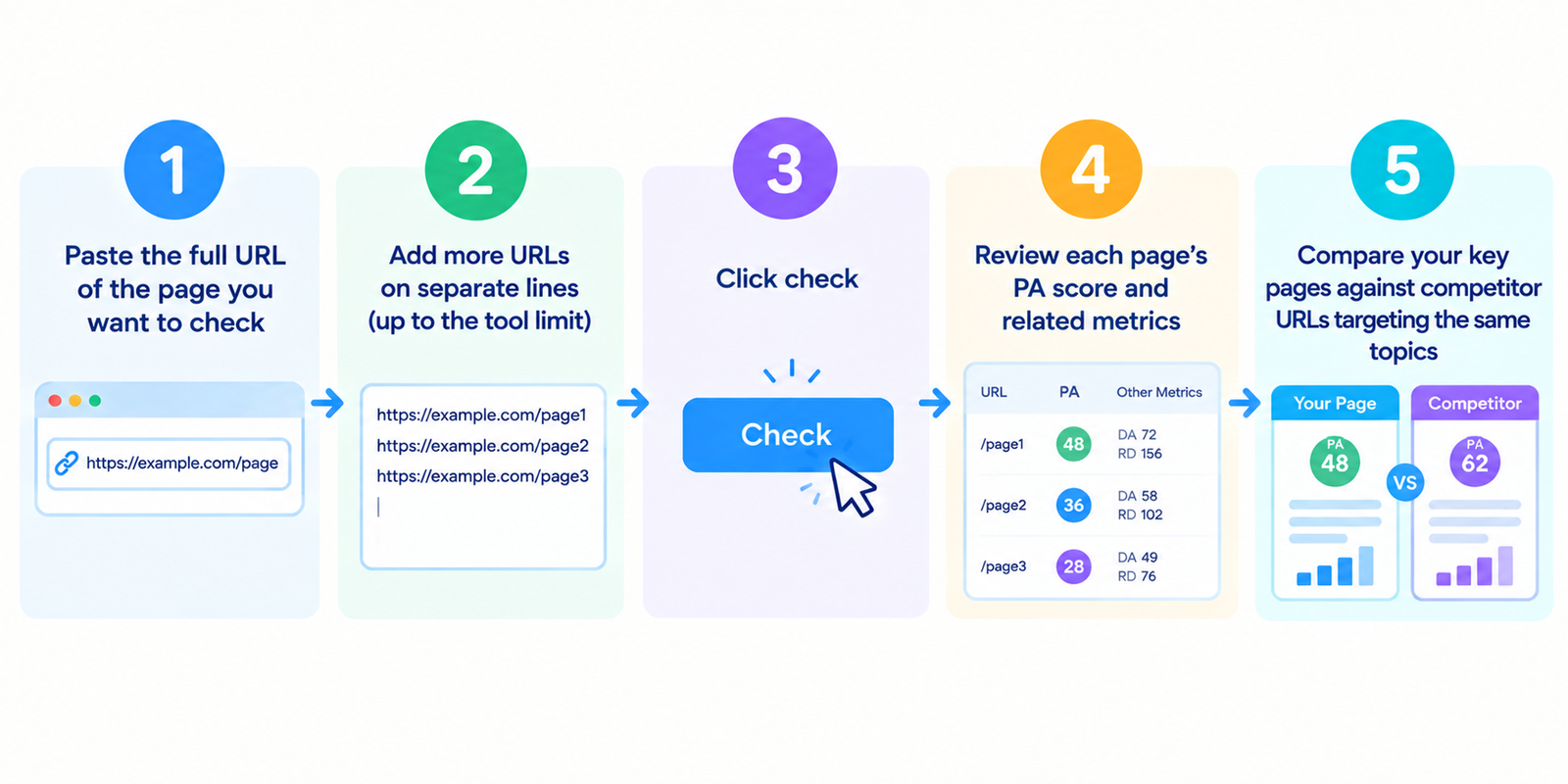
  1. Paste the full URL of the page you want to check
  2. Add more URLs on separate lines (up to the tool limit)
  3. Click check
  4. Review each page’s PA score and related metrics
  5. Compare your key pages against competitor URLs targeting the same topics

Use exact page URLs (not just the domain) for accurate page-level results.

What Page Authority Measures

Aspect Meaning
Focus Strength of one URL
Scale Typically 1–100
Signal type Link-based predictive metric
Best use Comparing pages and tracking relative strength

PA is not a Google ranking factor.
It is useful as a research benchmark because it often correlates with link equity patterns, but it does not decide rankings by itself.

Page Authority vs Domain Authority

Domain Authority (DA)
Estimates the overall strength of a website.

Page Authority (PA)
Estimates the strength of one specific page.

That is why:

  • A strong domain can still have weak individual pages
  • A newer site can have one highly linked page with relatively strong PA
  • Content strategy should look at both site-level and page-level signals

For page optimization and content prioritization, PA is often more actionable than DA alone.

How to Interpret PA Scores

There is no single “good” number for every niche. Compare similar pages.

Practical reading:

  • Lower PA — page has limited external support or is new
  • Mid-range PA — some established link equity
  • Higher PA — stronger page-level link profile relative to many others

Most useful questions:

  1. Which of my pages are strongest?
  2. How do they compare with ranking competitor pages?
  3. Which important URLs are under-supported internally/externally?

Practical Ways to Use Bulk PA Checks

Content prioritization
Identify which existing pages already have more authority and can support competitive topics.

Competitor page comparison
Check the exact competitor URL ranking for your keyword, not just their homepage.

Internal linking decisions
Point more internal links from stronger pages toward strategic URLs.

Progress tracking
Re-check the same URL set monthly/quarterly to watch direction, not daily noise.

What Usually Helps Page-Level Strength

PA models generally reflect page link equity patterns. In practice, stronger pages tend to have:

  • Relevant external links pointing to that specific URL
  • Supportive internal links from important site pages
  • Clear topical value worth citing
  • Clean technical access (indexable, reachable, stable)

Sustainable approach:

  1. Improve the page’s usefulness and depth
  2. Strengthen internal links to it
  3. Earn relevant mentions/links naturally
  4. Avoid spammy link schemes
  5. Re-measure over time

Chasing the score directly is less effective than improving the page’s real value and discoverability.

Limitations

  • PA is a third-party estimate, not a Google metric
  • New pages may show low/incomplete scores until link data matures
  • Tool indexes are not perfect mirrors of the whole web
  • High PA cannot save thin or irrelevant content
  • Scores can shift when third-party systems recalibrate

Use PA with rankings, traffic, and Search Console data for better decisions.

FAQ

Is this Page Authority Checker free?
Yes. Standard checks do not require an account.

Can PA be higher than DA?
Yes. A well-linked page can outscore the domain-level average.

Does higher PA guarantee rankings?
No. Relevance, content quality, intent match, and competition still matter.

How many URLs can I check?
Up to 20 per batch in the standard tool.

How often should I re-check?
Monthly or quarterly is usually enough for trend tracking.

Related tools

Note: Page Authority is a predictive, third-party metric. Treat it as a comparative signal for page-level strength, not as a direct ranking score from Google.