Page Authority Checker


Page Authority Checker
Suchmaschinen bewerten Seiten, nicht nur Domains.
Die Page Authority (PA) ist ein Score von Drittanbietern (von Moz), der die Ranking-Stärke einer spezifischen URL auf einer Skala von 1–100 schätzt. Mit diesem kostenlosen Tool können Sie die PA für einzelne Seiten überprüfen und diese direkt miteinander vergleichen.
Anwendung
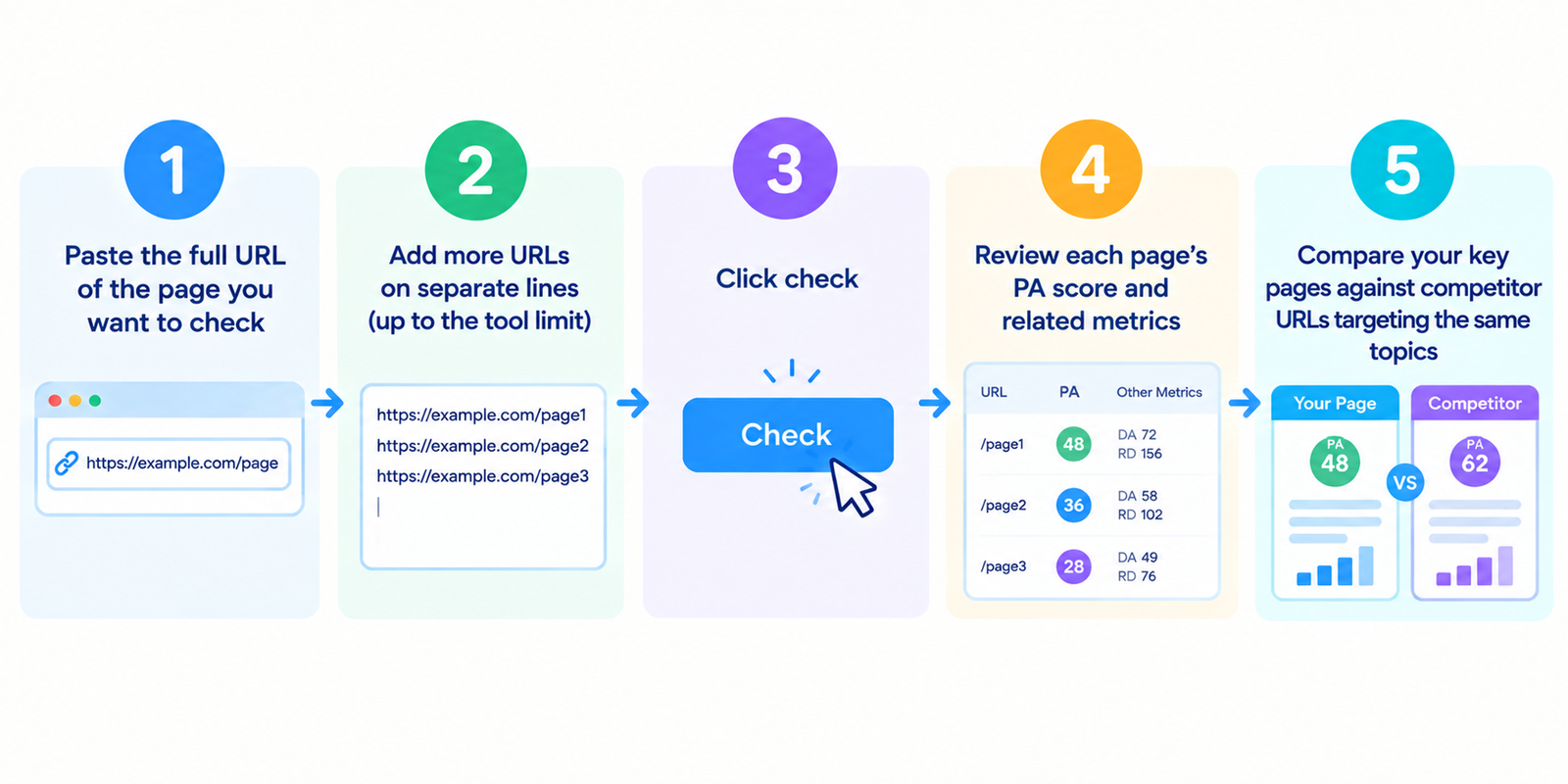
- Fügen Sie die vollständige URL der Seite ein, die Sie überprüfen möchten
- Fügen Sie weitere URLs in neuen Zeilen hinzu (bis zum Tool-Limit)
- Klicken Sie auf Überprüfen
- Überprüfen Sie den PA-Score und die zugehörigen Metriken jeder Seite
- Vergleichen Sie Ihre wichtigsten Seiten mit den URLs von Mitbewerbern, die auf dieselben Themen abzielen
Verwenden Sie exakte Seiten-URLs (nicht nur die Domain) für genaue Ergebnisse auf Seitenebene.
Was die Page Authority misst
| Aspekt | Bedeutung |
|---|---|
| Fokus | Stärke einer URL |
| Skala | Typischerweise 1–100 |
| Signaltyp | Linkbasierte prädiktive Metrik |
| Beste Verwendung | Vergleich von Seiten und Verfolgung der relativen Stärke |
Die PA ist kein Google-Rankingfaktor.
Sie ist als Recherche-Benchmark nützlich, da sie oft mit Link-Equity-Mustern korreliert, entscheidet jedoch nicht allein über Rankings.
Page Authority vs. Domain Authority
Domain Authority (DA)
Schätzt die Gesamtstärke einer Website.
Page Authority (PA)
Schätzt die Stärke einer bestimmten Seite.
Aus diesem Grund:
- Kann eine starke Domain dennoch schwache einzelne Seiten haben
- Kann eine neuere Website eine stark verlinkte Seite mit einer relativ starken PA haben
- Sollte die Content-Strategie sowohl Signale auf Site-Ebene als auch auf Seitenebene berücksichtigen
Für die Seitenoptimierung und die Priorisierung von Inhalten ist die PA oft aussagekräftiger als die DA allein.
Wie man PA-Scores interpretiert
Es gibt keine einheitliche „gute” Zahl für jede Nische. Vergleichen Sie ähnliche Seiten.
Praktische Einordnung:
- Niedrigere PA — Die Seite hat nur begrenzte externe Unterstützung oder ist neu
- Mittlere PA — Etwas etablierte Link-Equity
- Höhere PA — Stärkeres Linkprofil auf Seitenebene im Vergleich zu vielen anderen
Die nützlichsten Fragen:
- Welche meiner Seiten sind am stärksten?
- Wie schneiden sie im Vergleich zu den rankenden Mitbewerberseiten ab?
- Welche wichtigen URLs werden intern/extern unzureichend unterstützt?
Praktische Anwendungsmöglichkeiten für Bulk-PA-Prüfungen
Priorisierung von Inhalten
Finden Sie heraus, welche bestehenden Seiten bereits mehr Authority haben und wettbewerbsfähige Themen unterstützen können.
Vergleich von Mitbewerberseiten
Überprüfen Sie die genaue Mitbewerber-URL, die für Ihr Keyword rankt, und nicht nur deren Homepage.
Entscheidungen zur internen Verlinkung
Leiten Sie mehr interne Links von stärkeren Seiten auf strategische URLs.
Fortschrittsverfolgung
Überprüfen Sie dieselben URLs monatlich oder vierteljährlich, um den Trend und nicht das tägliche Rauschen zu beobachten.
Was der Stärke auf Seitenebene normalerweise hilft
PA-Modelle spiegeln im Allgemeinen Link-Equity-Muster von Seiten wider. In der Praxis weisen stärkere Seiten tendenziell Folgendes auf:
- Relevante externe Links, die auf diese spezifische URL verweisen
- Unterstützende interne Links von wichtigen Seiten der Website
- Eindeutigen thematischen Wert, der zitiert zu werden verdient
- Sauberen technischen Zugriff (indexierbar, erreichbar, stabil)
Nachhaltiger Ansatz:
- Verbessern Sie den Nutzen und die Tiefe der Seite
- Stärken Sie die internen Links darauf
- Generieren Sie auf natürliche Weise relevante Erwähnungen/Links
- Vermeiden Sie Spam-Link-Schemata
- Messen Sie im Laufe der Zeit erneut
Das direkte Jagen des Scores ist weniger effektiv, als den echten Wert und die Auffindbarkeit der Seite zu verbessern.
Einschränkungen
- Die PA ist eine Schätzung von Drittanbietern, keine Google-Metrik
- Neue Seiten weisen möglicherweise niedrige/unvollständige Scores auf, bis die Link-Daten reif sind
- Die Indizes der Tools sind kein perfektes Spiegelbild des gesamten Webs
- Eine hohe PA kann dünne oder irrelevante Inhalte nicht retten
- Scores können sich verschieben, wenn Systeme von Drittanbietern neu kalibriert werden
Verwenden Sie die PA zusammen mit Rankings, Traffic und Search Console-Daten für bessere Entscheidungen.
FAQ
Ist dieser Page Authority Checker kostenlos?
Ja. Standardprüfungen erfordern kein Konto.
Kann die PA höher sein als die DA?
Ja. Eine gut verlinkte Seite kann den Durchschnitt auf Domain-Ebene übertreffen.
Garantiert eine höhere PA Rankings?
Nein. Relevanz, Inhaltsqualität, Intention und Wettbewerb spielen weiterhin eine Rolle.
Wie viele URLs kann ich überprüfen?
Bis zu 20 pro Batch im Standard-Tool.
Wie oft sollte ich die Prüfung wiederholen?
Monatlich oder vierteljährlich reicht normalerweise aus, um Trends zu verfolgen.
Ähnliche Tools
- Domain Authority Checker
- Backlink Checker
- MozRank Checker
- Keyword Position Checker
- Link Analyzer Tool
Hinweis: Die Page Authority ist eine prädiktive Metrik von Drittanbietern. Betrachten Sie sie als vergleichendes Signal für die Stärke auf Seitenebene und nicht als direkten Ranking-Score von Google.