Bulk Page Authority Checker | Bingo Web Rabbit

Page Authority Checker


Inserisci fino a 20 collegamenti (ogni link deve essere su una riga separata)


Captcha

in lavorazione...


Prova nuovo URL

Bulk Page Authority Checker Measure Individual Page Strength Up to 20 URLs at Once

High Domain Authority is great. But Google ranks pages, not domains. Your homepage might have DA 50, but that doesn't guarantee your blog post from last week ranks for anything.

That's where Page Authority comes in. It measures the ranking strength of a specific URL – your homepage, a product page, a blog post, anything.

Our Bulk Page Authority Checker gives you this metric for up to 20 URLs in one go. Enter your list. Get each page's PA score, plus relevant metrics like Spam Score. No account required. No waiting for slow tools.

What Is Page Authority (PA)?

Page Authority is a score developed by Moz that predicts how well a specific web page will rank on search engine result pages. PA scores range from 1 to 100, with higher scores corresponding to a greater ability to rank.

Think of DA as the reputation of your entire website – like a restaurant's overall rating. PA is the rating for a single dish on the menu. A restaurant might have mediocre overall ratings (DA 30), but their signature pasta dish could be famous (PA 65). That dish can rank well even if the rest of the site is average.

Page Authority is not a Google ranking factor. Google doesn't see or use it. Instead, it's a predictive metric that correlates strongly with actual search performance because it's built on the same link-based principles as Google's own algorithms.

How Is Page Authority Calculated?

Moz uses a machine learning model that analyzes dozens of factors from their web index, which contains trillions of links. Key factors include:

  • Linking root domains – How many unique websites link to this specific page
  • Linking URLs – Total number of external URLs pointing to the page
  • MozRank and MozTrust – Moz's proprietary link quality and trust metrics
  • Followed vs. nofollowed links – Both matter, but followed links carry more weight
  • Internal linking structure – How other pages on your own site link to this page
  • Anchor text distribution – What words people use when linking to you
  • Age of links – Older, established links typically carry more authority
  • Spam Score – Low-quality or manipulative links can hurt your PA

Like DA, PA uses a logarithmic scale. It's significantly easier to grow your score from 20 to 30 than from 70 to 80. The top scores (90+) are reserved for pages on massive, globally authoritative sites like Wikipedia, CNN, or government domains.

Domain Authority vs. Page Authority: What's the Difference?

Both are Moz metrics on a 1‑100 scale. But they measure different things:

Domain Authority (DA)Page Authority (PA)
What it measuresStrength of the entire websiteStrength of a single URL
Best forComparing overall sites, evaluating link prospectsOptimizing specific pages, tracking content performance
How it changesSlowly, over months or yearsCan change faster when a page earns new links
When to useCompetitive analysis, site-wide SEO healthContent strategy, individual page optimization

For example, a blog post on a new site (DA 10) might have PA 35 because it earned several high-quality backlinks. Meanwhile, an old, neglected "About Us" page on a high‑DA site (DA 70) might only have PA 25 because no one links to it.

Which one matters more? It depends. For link building, many SEOs prioritize PA because you're getting a link from a specific page. For competitive analysis, DA helps you understand the playing field. For content optimization, PA tells you which of your pages already have authority and which need work.

How to Use the Bulk Page Authority Checker

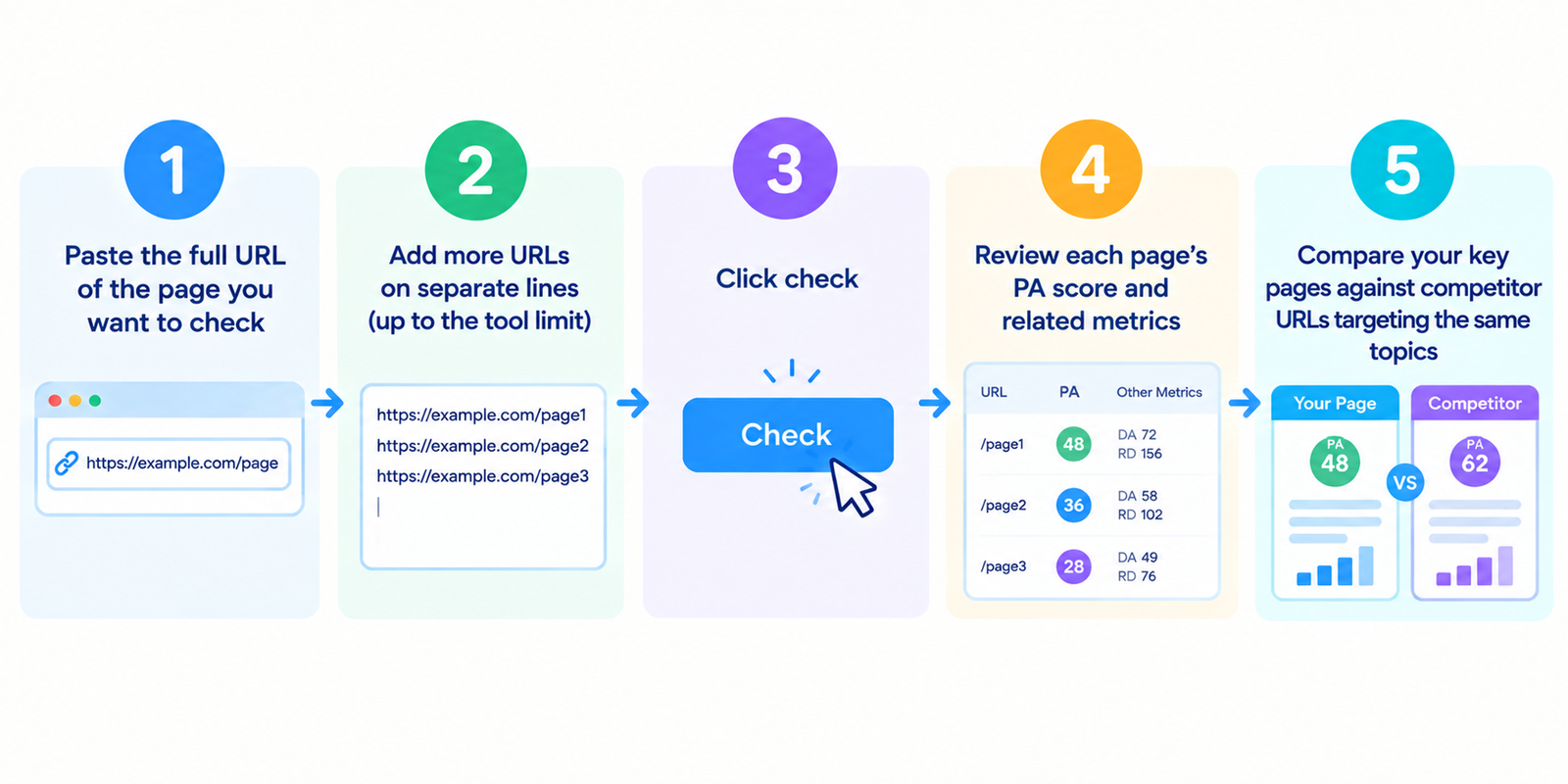
Step 1 – Open the Bulk Page Authority Checker on bingowebrabbit.com.

Step 2 – Enter the URLs you want to check. One per line. Up to 20 at once. Examples:

https://bingowebrabbit.com/page-speed-checker
https://bingowebrabbit.com/dns-lookup
https://bingowebrabbit.com/broken-links-finder

Step 3 – Click "Check Page Authority."

Step 4 – Wait a few seconds. The tool queries Moz's data and returns:

  • PA Score – Your page's authority on the 1‑100 scale
  • DA Score – The domain's overall authority (helpful context)
  • Spam Score – Percentage indicating risk of penalty (lower is better)
  • External Links – How many external domains link to this page
  • Total Links – All links pointing to this page (including internal)

Step 5 – Review and compare. Sort by PA to see which pages are strongest. Identify low‑PA pages that need attention.

What Is a Good Page Authority Score?

There's no universal "good" number. It depends on your industry and competition.

PA ScoreWhat It Means
1–20Very weak. New pages or pages with few (or very low‑quality) links. Needs significant improvement.
21–40Below average. May rank for very niche long‑tail keywords. Progress possible with focused link building.
41–60Good. Competitive for moderately difficult keywords. Most small to medium business sites aim for this range.
61–80Very strong. Ranks for highly competitive keywords. Requires significant link acquisition from authoritative sites.
81–100Elite. Pages on major publishers, government sites, or globally recognized brands. Extremely difficult for new sites to reach.

The most useful comparison is against your own pages. Which of your pages have the highest PA? Those are your best opportunities to rank for competitive terms. Which have the lowest? Those might need internal links or fresh backlinks.

Why Bulk Check Page Authority?

Checking one URL is easy. But real SEO work involves dozens or hundreds of pages:

  • Content audits – You have 50 blog posts. Which already have authority? Which need help? Run all 50 through our tool. Identify your top 10 and bottom 10 in seconds.
  • Competitive analysis – A competitor outranks you for "best running shoes." Check the PA of their top page and your corresponding page. If theirs is 55 and yours is 30, you know exactly how far behind you are.
  • Link building prospecting – You're building backlinks. You find 20 potential guest post opportunities. Check the PA of their key pages. Prioritize links from pages with PA 40+ over pages with PA 20.
  • Client reporting – Show a client exactly which of their pages have gained (or lost) authority month over month. Numbers they can understand and track.

How to Improve Your Page Authority

You can't raise PA directly. You raise it by doing things that make pages genuinely authoritative.

1. Earn high-quality backlinks to specific pages – This is the most effective method. Each external link from an authoritative page passes value to your page. Focus on earning links from PA 40+ pages in your industry, not from random directories.

2. Build internal links from your own high-PA pages – A page with PA 45 linking internally to a newer page passes significant authority. Add "related posts" sections, update old articles to link to new ones, and ensure your navigation highlights important pages.

3. Create content worth linking to – Backlinks don't appear by magic. Publish original research, data-driven guides, or genuinely useful resources that other sites want to reference.

4. Remove or disavow spammy links – Low-quality links won't necessarily destroy your PA, but excessive spam can trigger manual penalties, tanking your score. Use Google's Disavow Tool if you've been targeted by negative SEO or inherited a toxic backlink profile.

5. Improve technical SEO – Fast load times, mobile friendliness, and clean HTML make your page easier to crawl and index. This doesn't directly boost PA, but it ensures the authority you earn actually gets counted.

Spam Score: The Other Number You Need

Along with PA, our tool shows a Spam Score – a percentage (0–100) indicating how likely a domain is to be penalized or considered low-quality by search engines.

  • 0–5% – Low risk. Clean profile.
  • 6–15% – Moderate risk. Some questionable links.
  • 16–30% – High risk. Potentially manipulative link building.
  • 31%+ – Very high risk. Likely penalized or deindexed.

When evaluating link opportunities, avoid pages with high Spam Score. A link from a page with PA 45 but Spam Score 28% might hurt more than it helps.

Frequently Asked Questions

Is Page Authority a Google ranking factor? No. It's a third‑party metric developed by Moz. Google doesn't use it. However, the factors that increase PA (quality backlinks, strong content, clean technical SEO) are the same factors that help you rank.

Can PA be higher than DA? Yes, frequently. A well‑linked blog post on an otherwise weak domain can have PA higher than the domain's DA. That's normal and desirable.

Why does my PA fluctuate? Moz updates its algorithm periodically. A drop doesn't necessarily mean your page lost links – Moz may have recalibrated how it measures or competitors may have gained authority faster.

Is there a free way to check PA? Yes. Our tool provides free bulk PA checks for normal usage. For extensive bulk queries, contact us for API access.

How often should I check PA? Monthly or quarterly is sufficient. PA changes slowly. Checking daily will only cause unnecessary worry.

What's the difference between PA and Ahrefs URL Rating? Both measure similar concepts – page‑level link authority. Ahrefs calls theirs "URL Rating" (UR). Neither is "better" – choose one tool and track consistently.

Limitations (Be Honest)

  • Not a Google metric – PA doesn't guarantee rankings. Use it as a directional guide, not a promise.
  • Moz's index is not the whole web – Some pages may be missing or have incomplete link data.
  • New pages may have no PA – A page published yesterday won't have meaningful PA until it's crawled and linked.
  • PA ignores on‑page content quality – A page with PA 60 but terrible, thin content won't rank well. Backlinks alone aren't enough.

Final Words

Page Authority helps you understand which of your pages have real ranking potential. Use it to prioritise link building, identify your strongest content, and spot pages that are falling behind.

Our Bulk Page Authority Checker makes this easy. Enter up to 20 URLs. Get PA, DA, and Spam Score for each. No signup, no delays, no hidden fees.